ORINVEY

Tomorrow's Headlines, Today

ORINVEY FORECAST RECORD

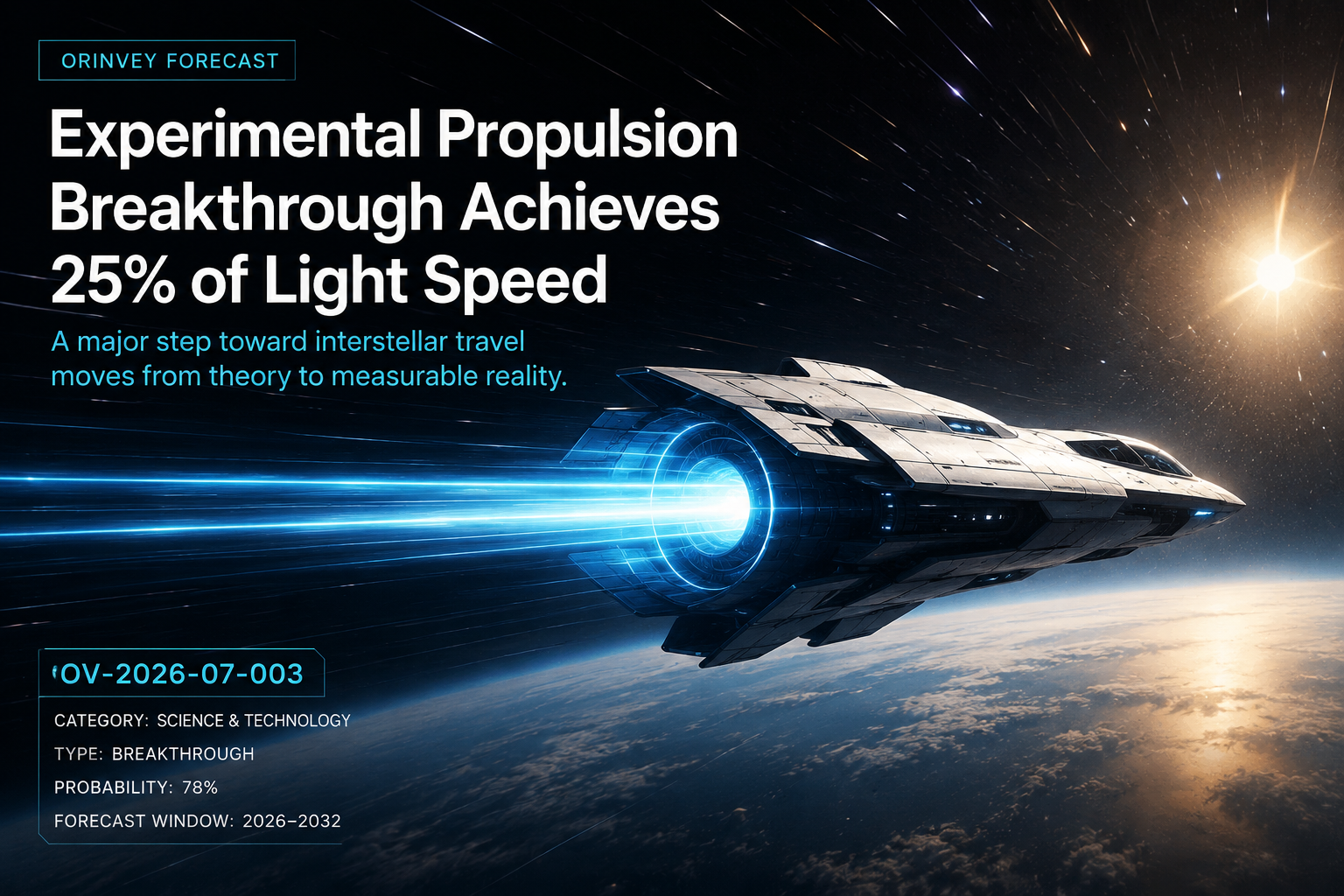
Humanity Reaches 25% of the Speed of Light in Historic Propulsion Breakthrough

For the first time in human history, a spacecraft has achieved 25% of the speed of light during a controlled propulsion test, fundamentally changing the future of space exploration. The demonstration, conducted through an international collaboration of government agencies, universities, and private aerospace companies, validates decades of theoretical research into next-generation propulsion systems. Whether powered by advanced fusion, antimatter-assisted engines, directed energy, or another breakthrough technology, the achievement proves that relativistic travel is no longer confined to science fiction. At approximately 75 million meters per second, the vehicle completed a sustained acceleration and navigation test while maintaining structural integrity and communication with Earth-based tracking stations. Scientists immediately hailed the event as one of the defining technological milestones of the century. While the spacecraft remains unmanned, the implications extend far beyond a single mission. Travel times to the outer planets could be reduced dramatically, transforming exploration of the Solar System. More importantly, nearby star systems that once required tens of thousands of years to reach could now be approached within a human lifetime using future generations of even faster propulsion technologies. The breakthrough also accelerates development in numerous related fields, including advanced materials, radiation shielding, artificial intelligence, autonomous spacecraft operations, energy generation, and deep-space communications. Government investment in interstellar infrastructure expands rapidly following the successful demonstration, while commercial aerospace firms begin competing to commercialize the technology for scientific, industrial, and eventually human missions. Although significant engineering challenges remain before crewed interstellar travel becomes practical, historians point to this achievement as the moment humanity officially entered the early Interstellar Age. Future generations may remember this milestone in much the same way previous centuries remembered the Wright brothers’ first flight or the Apollo 11 Moon landing—not because it represented the end of a journey, but because it proved an entirely new era had begun. ⸻ OrinVey Assessment A successful demonstration of 25% light-speed propulsion would represent one of the most consequential technological achievements in human history. Beyond space exploration, the innovation would trigger advances across physics, energy, computing, manufacturing, and international cooperation. The effects would likely reshape civilization over the following decades, making this a defining milestone in humanity’s long-term expansion beyond Earth.

Humanity Reaches 25% of the Speed of Light in Historic Propulsion Breakthrough
Technology // Technology Watch

Future Dispatch

For the first time in human history, a spacecraft has achieved 25% of the speed of light during a controlled propulsion test, fundamentally changing the future of space exploration. The demonstration, conducted through an international collaboration of government agencies, universities, and private aerospace companies, validates decades of theoretical research into next-generation propulsion systems. Whether powered by advanced fusion, antimatter-assisted engines, directed energy, or another breakthrough technology, the achievement proves that relativistic travel is no longer confined to science fiction. At approximately 75 million meters per second, the vehicle completed a sustained acceleration and navigation test while maintaining structural integrity and communication with Earth-based tracking stations. Scientists immediately hailed the event as one of the defining technological milestones of the century. While the spacecraft remains unmanned, the implications extend far beyond a single mission. Travel times to the outer planets could be reduced dramatically, transforming exploration of the Solar System. More importantly, nearby star systems that once required tens of thousands of years to reach could now be approached within a human lifetime using future generations of even faster propulsion technologies. The breakthrough also accelerates development in numerous related fields, including advanced materials, radiation shielding, artificial intelligence, autonomous spacecraft operations, energy generation, and deep-space communications. Government investment in interstellar infrastructure expands rapidly following the successful demonstration, while commercial aerospace firms begin competing to commercialize the technology for scientific, industrial, and eventually human missions. Although significant engineering challenges remain before crewed interstellar travel becomes practical, historians point to this achievement as the moment humanity officially entered the early Interstellar Age. Future generations may remember this milestone in much the same way previous centuries remembered the Wright brothers’ first flight or the Apollo 11 Moon landing—not because it represented the end of a journey, but because it proved an entirely new era had begun. ⸻ OrinVey Assessment A successful demonstration of 25% light-speed propulsion would represent one of the most consequential technological achievements in human history. Beyond space exploration, the innovation would trigger advances across physics, energy, computing, manufacturing, and international cooperation. The effects would likely reshape civilization over the following decades, making this a defining milestone in humanity’s long-term expansion beyond Earth.

A revolutionary propulsion system successfully accelerates an unmanned spacecraft to one-quarter the speed of light, marking the greatest leap in transportation technology since the dawn of the Space Age and opening the path toward practical interstellar exploration.

Evidence Timeline

July 4, 2026 — Forecast Published Forecast entered into the Orinvey archive.

Revision History

Original forecast preserved. Updates are recorded as separate timeline events.

The future deserves a history.