Future Dispatch
A patient becomes the first person to receive multiple fully lab-grown replacement organs, demonstrating that regenerative medicine has advanced beyond individual organ transplants and into complete organ system replacement.
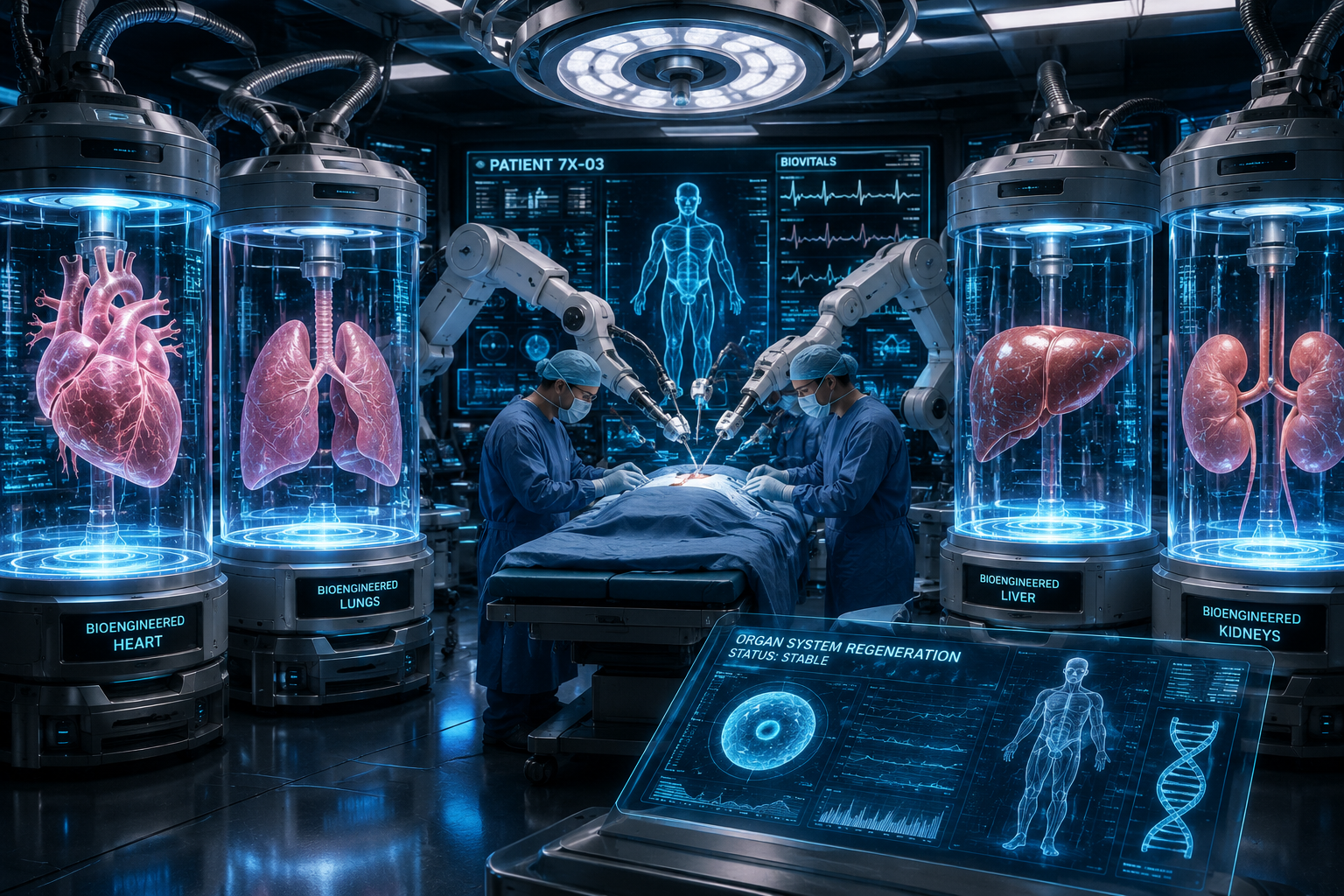
In what medical experts are calling one of the most significant healthcare breakthroughs of the modern era, surgeons have successfully implanted a complete set of laboratory-grown organs into a single patient, eliminating the need for donor organs and dramatically reducing the risk of transplant rejection.
The procedure follows decades of progress in stem cell research, regenerative medicine, three-dimensional bioprinting, and tissue engineering. Rather than relying on organs donated after death, physicians created personalized replacement organs using the patient’s own genetic material, allowing the body’s immune system to recognize the new tissues as its own.
The historic surgery replaced multiple failing organs during a single coordinated procedure. Over the following months, doctors reported that the transplanted organs demonstrated normal function without the long-term dependence on powerful anti-rejection medications traditionally required after transplantation.
Medical researchers believe the achievement represents the beginning of a new era in personalized medicine.
Worldwide, more than a million people are currently waiting for life-saving organ transplants or are expected to require one during their lifetime. Chronic shortages of donor organs have remained one of healthcare’s greatest challenges for decades. The ability to manufacture replacement organs on demand could fundamentally reshape modern medicine.
Beyond transplantation, the same technology is expected to accelerate treatments for traumatic injuries, congenital birth defects, military medicine, and age-related organ failure. Pharmaceutical companies also anticipate using bioengineered organs to improve drug testing, reducing the need for animal studies while producing more accurate human-specific results.
Governments and healthcare systems begin investing heavily in regional biofabrication centers capable of producing personalized organs locally, while international regulators work to establish safety standards for this rapidly growing field.
Although the procedure remains expensive during its early years, experts expect costs to decline significantly as manufacturing techniques improve and production scales increase, making personalized organ replacement increasingly accessible to patients around the world.
Many historians later compare the milestone to the first successful heart transplant, recognizing it not simply as another medical advance, but as the beginning of a future in which organ failure is no longer considered a permanent or fatal condition.
⸻
OrinVey Assessment
The successful replacement of an entire organ system using lab-grown tissues would represent one of the greatest advances in medical history. It would transform transplant medicine, extend healthy life expectancy, reduce dependence on organ donors, and accelerate regenerative therapies across nearly every field of healthcare. If realized, this breakthrough would mark the transition from treating organ failure to effectively manufacturing replacement biology.