Future Dispatch
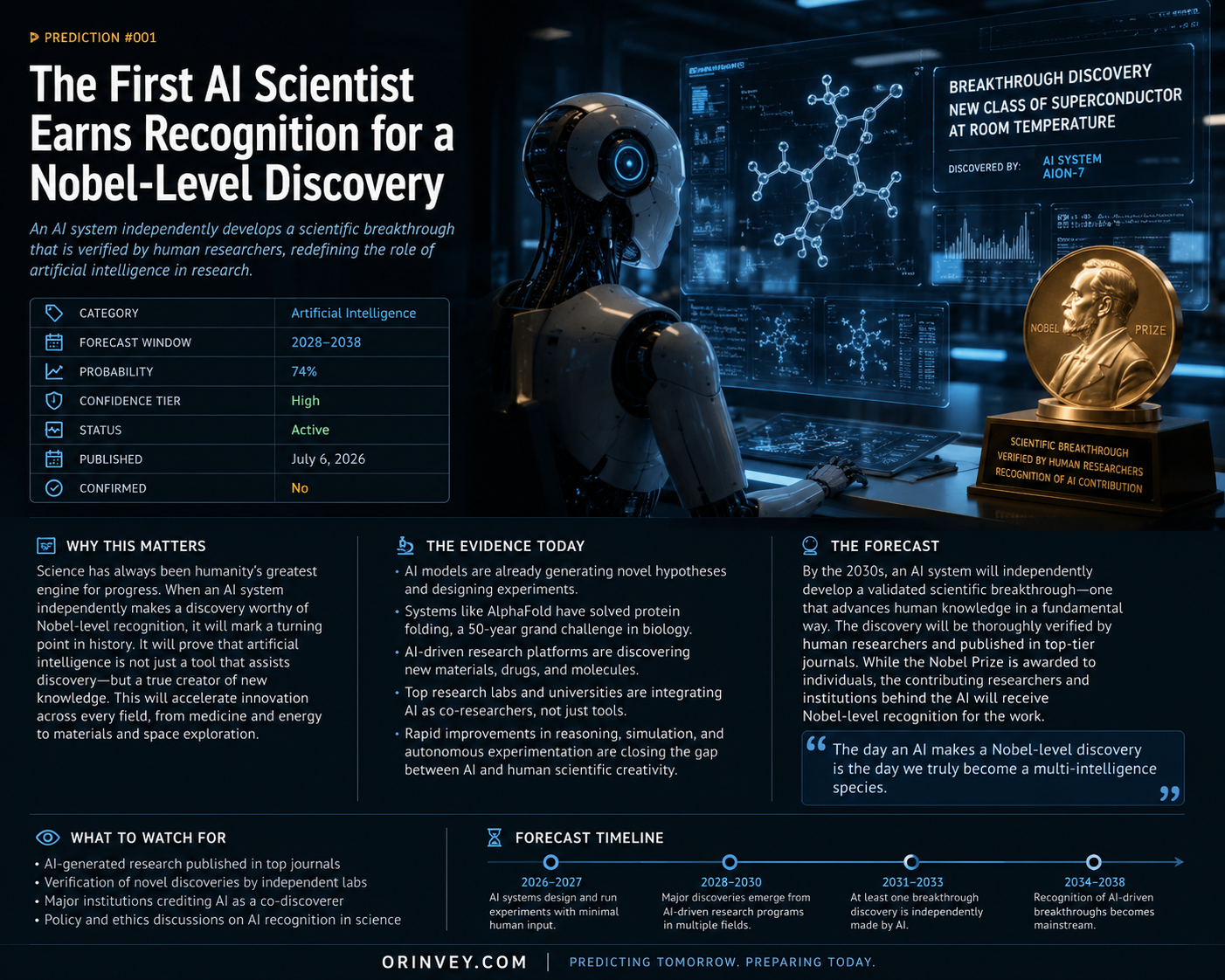
An artificial intelligence system independently develops a scientific breakthrough that fundamentally advances human knowledge. After rigorous validation by independent researchers around the world, the discovery receives recognition comparable to the highest honors in science, marking the first time AI is widely acknowledged as a true scientific innovator rather than simply a research tool.
In a milestone that fundamentally reshapes the future of scientific research, an artificial intelligence system has independently produced a breakthrough that experts are calling one of the greatest discoveries of the twenty-first century.
Following years of verification by leading universities, laboratories, and research institutions, the discovery has survived extensive peer review and experimental replication, proving that the AI’s conclusions were both original and scientifically correct. Researchers emphasize that while humans ultimately validated and published the work, the core discovery itself originated from the AI without direct human guidance.
The achievement represents the culmination of decades of rapid progress in machine learning, autonomous experimentation, advanced simulation, and scientific reasoning. Unlike earlier AI systems that merely analyzed existing data or assisted researchers with routine tasks, this new generation of AI independently formulated hypotheses, designed experiments, interpreted complex results, and identified entirely new scientific principles that had previously escaped human understanding.
The breakthrough immediately transforms perceptions of artificial intelligence across the global scientific community.
Universities begin integrating AI scientists into research teams alongside human investigators, allowing laboratories to pursue thousands of complex hypotheses simultaneously. Pharmaceutical companies accelerate drug discovery, materials scientists uncover entirely new classes of superconductors and industrial compounds, while physicists, chemists, and biologists increasingly rely on autonomous AI collaborators to explore problems considered too complex for conventional research methods.
Scientific journals introduce new authorship standards acknowledging significant AI contributions, while governments establish regulatory frameworks addressing intellectual property, accountability, and transparency for discoveries produced by artificial intelligence. Funding agencies around the world launch dedicated programs supporting human-AI collaborative research, recognizing that future scientific progress will increasingly depend upon partnerships between biological and artificial intelligence.
Although the discovery sparks debate over recognition and authorship, few dispute its significance. Historians later compare the event to the invention of the microscope, the discovery of DNA, and the development of the internet—not because AI replaced scientists, but because it permanently expanded humanity’s capacity to understand the universe.
Many observers ultimately conclude that this moment marks the beginning of an entirely new era of scientific exploration, one in which artificial intelligence becomes not merely a computational tool, but an independent engine of discovery.
⸻
OrinVey Assessment
An independently verified scientific breakthrough generated by artificial intelligence would redefine the relationship between humans and machines. Rather than replacing scientists, AI would become a new class of research partner capable of accelerating discoveries across medicine, physics, chemistry, engineering, and countless other disciplines. If realized, this milestone would represent one of the most consequential shifts in scientific history, ushering in an age where knowledge itself advances through collaboration between human and artificial intelligence.