Future Dispatch
A newly developed urban district becomes the first community in the world to operate almost entirely through artificial intelligence, autonomous transportation, and self-managing infrastructure, redefining how future cities are designed and governed.
A purpose-built urban district has officially become the world’s first community to function almost entirely through autonomous systems, marking a historic milestone in the evolution of smart cities.
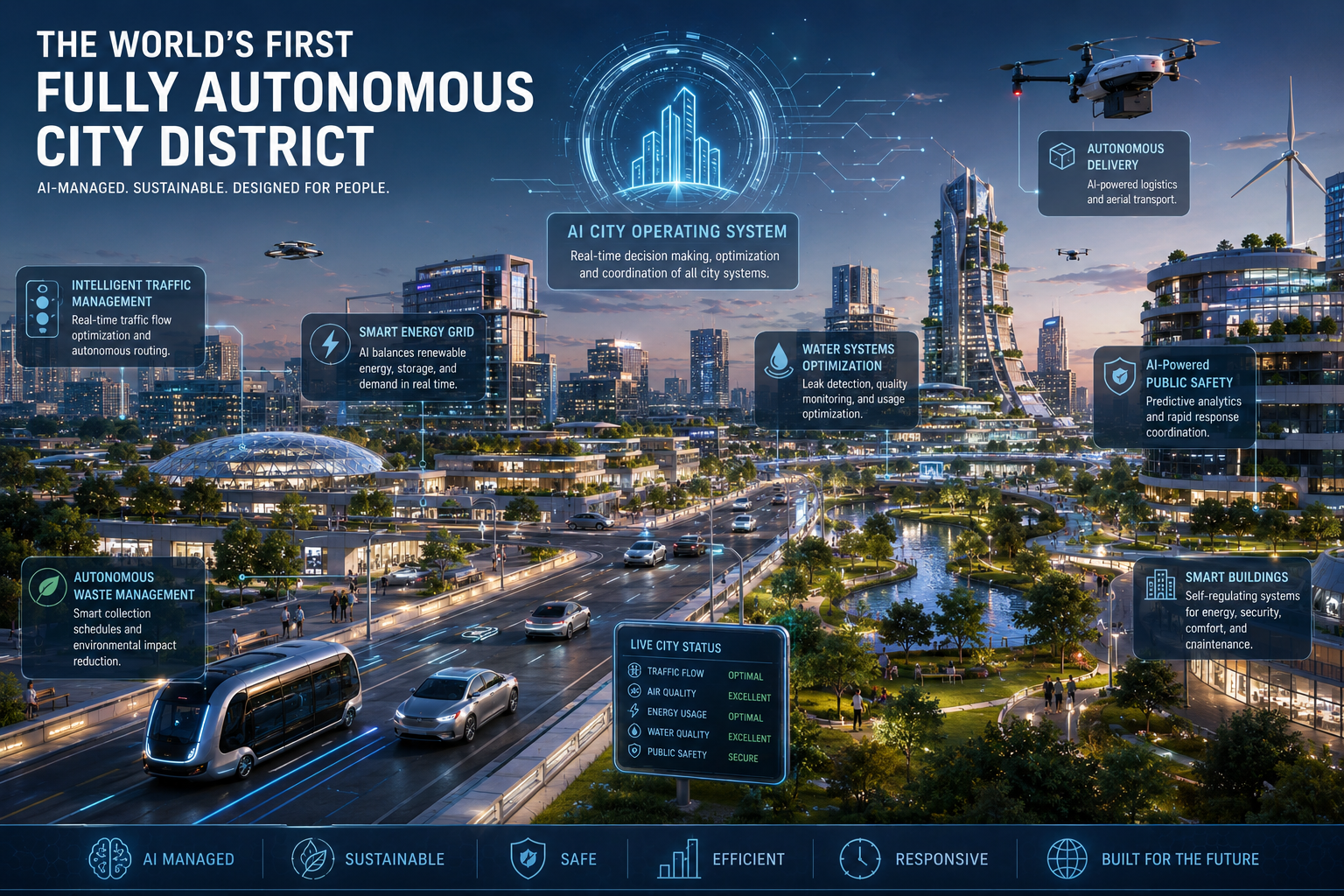
Unlike previous “smart city” projects that merely connected traffic lights, security cameras, and public services to the internet, this district was designed from the ground up around artificial intelligence. Every major system—from transportation and utilities to emergency response, waste collection, energy distribution, and environmental monitoring—operates through a unified digital management platform.
Residents navigate the city using fleets of autonomous public vehicles that dynamically adjust routes based on real-time demand. Delivery drones and robotic service vehicles handle much of the community’s logistics, while AI-controlled traffic systems virtually eliminate congestion by coordinating every moving vehicle within the district.
The city’s electrical grid continuously balances renewable energy production, battery storage, and consumption across homes and businesses. Water usage, waste collection, and building maintenance are optimized automatically through millions of interconnected sensors, reducing operating costs while improving efficiency.
Emergency services also benefit from predictive technology. Artificial intelligence continuously monitors infrastructure, weather conditions, and public safety data, allowing potential emergencies to be identified before they escalate. In many cases, maintenance crews or emergency responders are dispatched before residents are even aware of developing problems.
Supporters argue that the district demonstrates how rapidly growing populations can be accommodated while lowering emissions, reducing traffic, conserving resources, and improving quality of life. Critics, however, raise concerns about cybersecurity, data privacy, and the concentration of decision-making within automated systems.
Despite the debate, governments and developers from around the world begin studying the project as a potential blueprint for future urban development. Several nations announce plans to construct similar AI-managed communities, accelerating the global shift toward highly automated cities.
Urban planners increasingly view the opening of the autonomous district as a turning point comparable to the arrival of electrification, mass transit, or the internet. While traditional cities will continue to evolve gradually, this project demonstrates what a fully integrated, AI-managed community can achieve when designed from the ground up.
⸻
OrinVey Assessment
The world’s first fully autonomous city district would represent a defining moment in urban development. By integrating transportation, utilities, emergency services, and infrastructure under a unified AI platform, it would serve as a real-world test of how automation can reshape everyday life. If successful, the model could influence city planning across the globe for decades, much as skyscrapers, interstate highways, and broadband networks transformed previous generations.