Future Dispatch
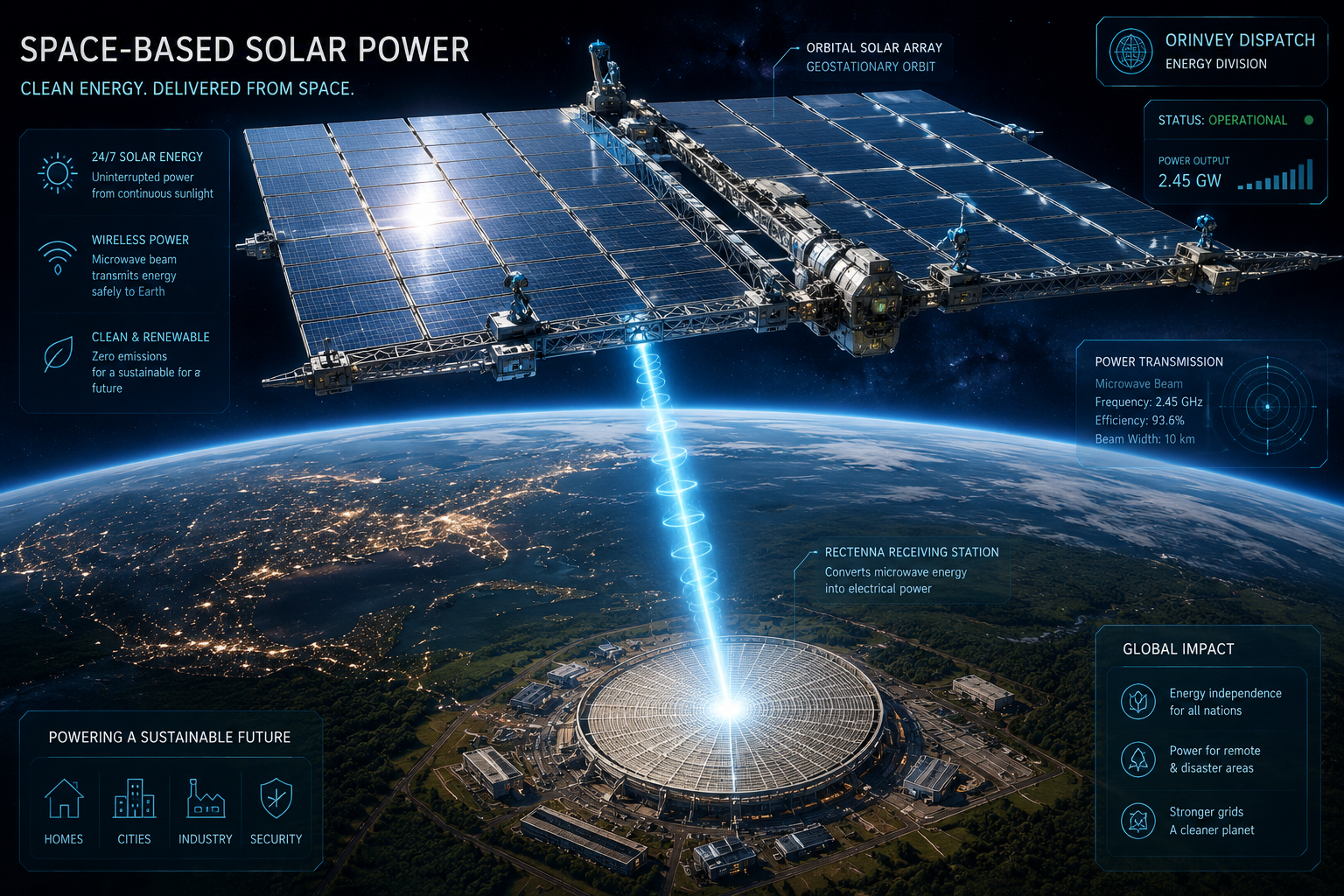
The world’s first commercial space-based solar power station successfully begins transmitting electricity from orbit to Earth, demonstrating that uninterrupted, clean energy can be generated in space and delivered to ground-based power grids on a commercial scale.
A decades-old vision of limitless clean energy has become reality as the world’s first commercial space-based solar power station officially begins supplying electricity to consumers on Earth.
Unlike traditional solar farms that lose production overnight or during cloudy weather, orbital solar arrays operate in nearly continuous sunlight, generating electricity around the clock. Massive lightweight solar panels positioned in geostationary orbit collect solar energy and convert it into focused microwave or laser beams directed toward specially designed receiving stations on Earth’s surface.
The receiving facilities, known as rectennas, convert the incoming energy into electricity before feeding it directly into regional power grids. Early testing demonstrates stable transmission with minimal atmospheric loss and no measurable risk to aircraft, wildlife, or surrounding communities.
The inaugural station provides only a modest share of electricity, but energy analysts describe the achievement as comparable to the first commercial nuclear reactor or the first offshore wind farm. It proves that harvesting solar energy in space is no longer confined to scientific theory.
Construction of the orbital power station relied heavily on reusable launch systems, autonomous assembly robots, and lightweight composite materials that dramatically reduced launch costs compared with previous decades. Future stations are expected to become larger and more efficient as manufacturing expands into Earth orbit.
Governments and private energy companies quickly announce plans for additional orbital power facilities capable of supplying electricity to remote communities, military installations, disaster zones, and nations with limited renewable energy resources. Developing countries also express interest in purchasing power from international orbital energy networks rather than investing in massive ground infrastructure.
Environmental organizations cautiously welcome the technology, noting its potential to reduce dependence on fossil fuels while avoiding many of the land-use challenges associated with conventional solar farms. Critics, however, raise questions about orbital congestion, long-term maintenance, cybersecurity, and international regulation of energy transmission from space.
Despite these concerns, investment accelerates as utilities recognize the value of predictable, continuous renewable power. Within a few years, several additional orbital stations are under construction, signaling the beginning of a new chapter in global energy production.
⸻
OrinVey Assessment
Commercial space-based solar power would represent one of the most important energy breakthroughs of the 21st century. By providing continuous renewable electricity independent of weather or daylight, orbital solar stations could strengthen electrical grids, improve energy security, and reduce global carbon emissions. While significant engineering and economic challenges remain, continued advances in reusable rockets, robotic construction, wireless power transmission, and space manufacturing make this a plausible long-term milestone rather than science fiction.