Future Dispatch
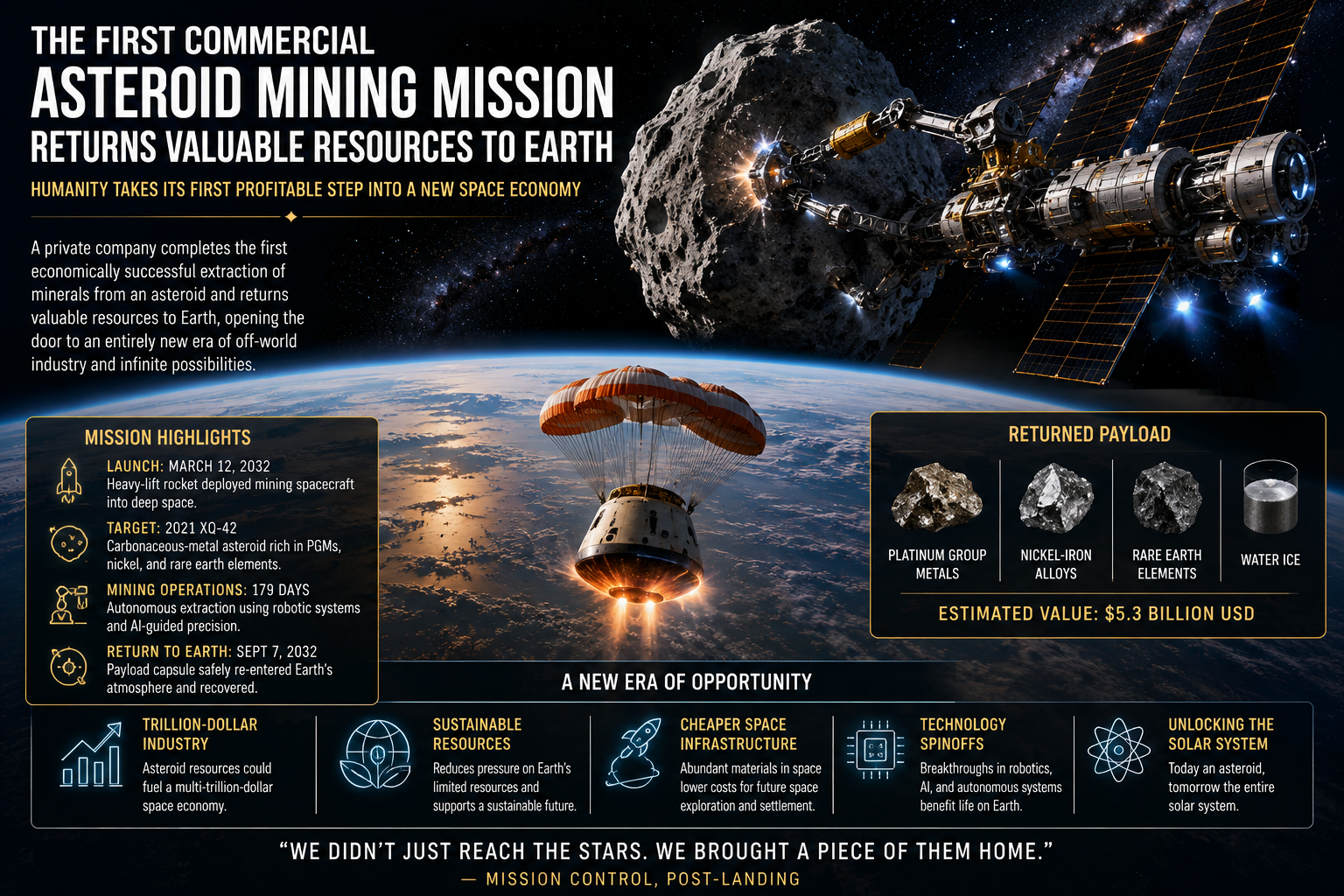
A private aerospace company successfully completes the first economically viable asteroid mining mission, returning valuable metals and other resources to Earth while proving that off-world resource extraction can become a profitable new industry.
In a milestone that signals the beginning of the space economy, a private aerospace company has successfully completed the world’s first profitable asteroid mining mission, returning valuable extraterrestrial materials safely to Earth.
The historic mission targeted a near-Earth asteroid rich in platinum-group metals, nickel, cobalt, and rare earth elements. Using autonomous mining robots and artificial intelligence-guided extraction systems, the spacecraft spent several months collecting and processing raw material before returning a sealed cargo capsule to Earth.
Following recovery and laboratory analysis, scientists confirmed that the mission successfully returned commercially valuable quantities of refined asteroid material. Independent economic assessments concluded that the value of the recovered resources exceeded the total cost of the mission, making it the first asteroid mining expedition to demonstrate commercial profitability.
The achievement marks a turning point for the global space industry.
For decades, asteroid mining remained largely theoretical due to the enormous costs of launch vehicles, spacecraft development, and autonomous operations. Rapid advances in reusable rockets, robotic mining systems, artificial intelligence, and in-space navigation dramatically reduced mission costs, allowing private industry to accomplish what had once been considered science fiction.
Financial markets responded immediately. Aerospace companies, mining corporations, and institutional investors announced billions of dollars in new investments aimed at expanding off-world resource extraction. Several governments accelerated legislation establishing legal frameworks governing ownership rights, environmental protections, and commercial activity beyond Earth.
Scientists emphasize that asteroid mining offers benefits extending well beyond Earth’s economy.
Future missions are expected to harvest water ice that can be converted into drinking water, breathable oxygen, and rocket fuel for deep-space exploration. Rather than launching every kilogram of fuel from Earth, future spacecraft could refuel in orbit using resources extracted directly from asteroids, dramatically lowering the cost of missions to the Moon, Mars, and beyond.
Industrial metals produced in space may also reduce pressure on environmentally sensitive mining operations on Earth. Rare minerals critical for batteries, renewable energy systems, advanced electronics, and semiconductor manufacturing could eventually be sourced from space without disturbing terrestrial ecosystems.
The technological breakthroughs developed during the mission—including autonomous robotics, AI-controlled excavation systems, precision navigation, and advanced resource processing—quickly find applications across industries on Earth, improving mining safety, automation, manufacturing, and remote operations.
Although regulatory questions surrounding space resource ownership continue to evolve, international cooperation increases as nations recognize that the solar system contains virtually unlimited raw materials capable of supporting centuries of economic growth.
Historians later compare the mission to the first commercial oil well, the opening of the transcontinental railroad, and the beginning of the aviation industry. What had long been viewed as an ambitious scientific experiment ultimately becomes the foundation of humanity’s first truly extraterrestrial economy.
⸻
OrinVey Assessment
Commercial asteroid mining has the potential to become one of the defining industries of the twenty-first century. While significant engineering, financial, and regulatory challenges remain, continued advances in reusable launch systems, autonomous robotics, artificial intelligence, and spacecraft manufacturing are steadily bringing this vision closer to reality. A profitable asteroid mining mission would fundamentally transform the economics of space exploration, reduce dependence on Earth’s finite resources, and establish the first permanent commercial supply chain beyond our planet. If realized, this milestone would represent the moment humanity ceased viewing space solely as a destination and began treating it as an economic frontier.