Future Dispatch
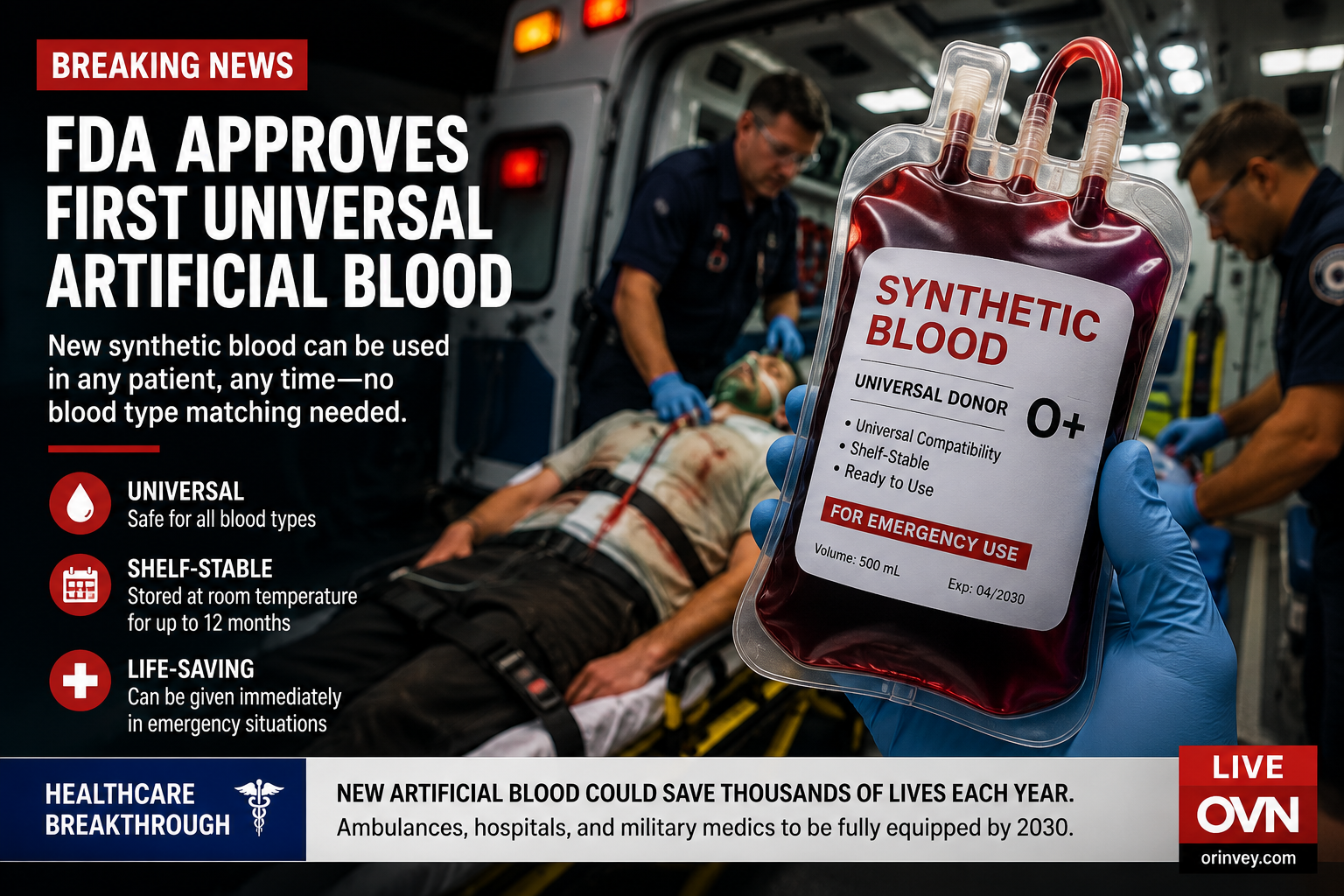
The U.S. Food and Drug Administration approves the nation’s first shelf-stable universal artificial blood product, allowing paramedics, military medics, and hospitals to transfuse trauma patients without knowing their blood type. The breakthrough dramatically reduces preventable deaths caused by blood loss.
WASHINGTON — In what trauma surgeons are calling the biggest advancement in emergency medicine in decades, federal regulators have approved the first commercially available artificial blood product for widespread emergency use across the United States.
Unlike donated human blood, the synthetic oxygen-carrying solution requires no blood-type matching, remains stable for months without refrigeration, and can be administered immediately following severe injuries.
The approval follows years of successful clinical trials involving automobile accidents, natural disasters, battlefield injuries, and rural emergency services where traditional blood supplies were unavailable.
For the first time, every ambulance in America will begin carrying blood capable of being safely transfused into virtually any patient.
Medical officials estimate that thousands of lives could be saved each year simply because treatment can begin minutes earlier.
Military leaders have already announced plans to stock every combat medic with multiple units before deployment.
Air ambulance providers, search-and-rescue teams, cruise ships, offshore oil platforms, and remote mining operations are also expected to adopt the technology rapidly.
Researchers believe the approval will significantly reduce the need for emergency blood drives during disasters while easing chronic blood shortages that have plagued hospitals for decades.
Although donated blood will continue to be necessary for many specialized treatments, physicians believe artificial blood will become the new standard for trauma care.
Experts are comparing today’s announcement to the introduction of antibiotics, automated defibrillators, and modern organ transplantation—medical advances that fundamentally changed survival rates.
⸻
Why This Matters
Trauma remains one of the leading causes of death for people under 45, with uncontrolled bleeding responsible for a large share of those fatalities. Universal artificial blood has the potential to remove one of emergency medicine’s biggest limitations: the need to identify blood type and maintain refrigerated donor supplies.
If successful, the technology could become standard equipment in every ambulance, military vehicle, helicopter, and emergency room worldwide.