Future Dispatch
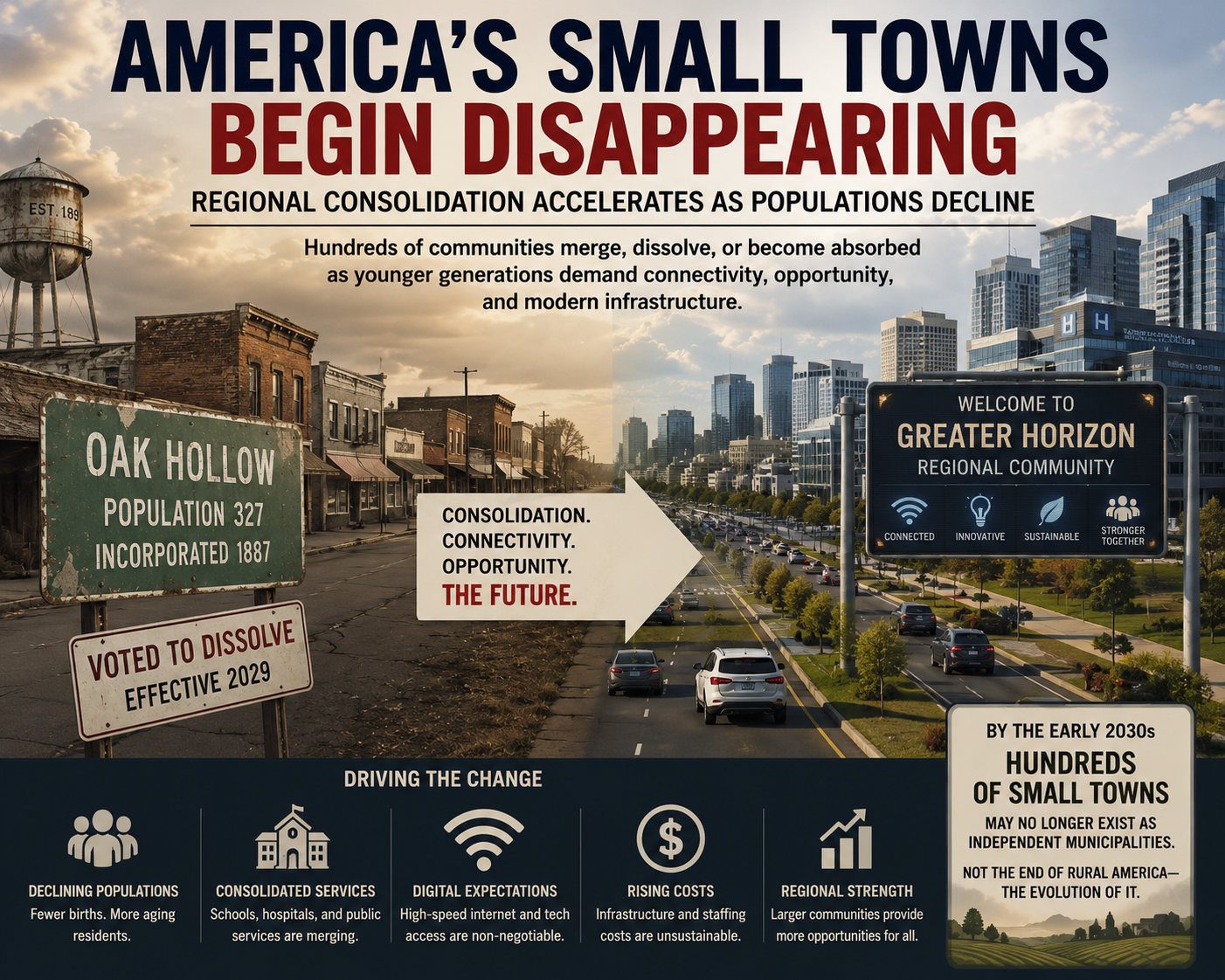
Facing shrinking populations, aging residents, and rising infrastructure costs, hundreds of America’s smallest communities begin dissolving into larger regional municipalities. As younger generations seek technology, healthcare, entertainment, and modern conveniences, many small towns struggle to survive independently.
WASHINGTON — A demographic trend that has been quietly reshaping rural America for decades has reached a tipping point.
Across the country, hundreds of America’s smallest towns are voting to dissolve municipal governments, merge with neighboring communities, or become unincorporated areas after years of declining populations and mounting financial pressures.
While many longtime residents blame economics, urban planners point to a broader cultural transformation.
The Baby Boomer generation, which often fought to preserve long-standing traditions and local institutions, is steadily giving way to younger generations that place greater value on connectivity, convenience, and access to opportunity than on maintaining municipal boundaries.
Communities that once supported independent grocery stores, banks, pharmacies, and hardware stores now rely on regional shopping centers and online retailers.
High-speed internet has become as essential as electricity, yet many rural communities cannot afford the infrastructure necessary to compete with nearby cities.
Schools are consolidating into larger districts. Volunteer fire departments struggle to recruit members. Hospitals continue to close, forcing residents to travel farther for healthcare.
Rather than attempting to reverse decades of decline, many state governments are encouraging regional cooperation.
Police departments, utility systems, public works, and administrative services are increasingly being shared among multiple communities, dramatically reducing operating costs.
Some municipalities have gone even further, choosing to merge entirely.
Residents say little changes in their daily lives except for the name on the welcome sign.
Others see something far more significant disappearing.
Historic downtowns that once served as the heart of local life are increasingly being converted into museums, tourism districts, or residential neighborhoods as commercial activity shifts toward larger population centers.
Experts stress that this is not the death of rural America.
Instead, they describe it as the evolution of rural America into larger, more connected regional communities that can better support modern healthcare, education, broadband infrastructure, and economic development.
By the early 2030s, researchers estimate that hundreds of America’s smallest incorporated towns may no longer exist as independent municipalities—not because they were abandoned, but because the practical advantages of consolidation outweighed the desire to preserve historic boundaries.
⸻
Why This Matters
For more than a century, the small town has been one of the defining symbols of American identity. Yet demographics, technology, and economics are reshaping how communities function.
The next generation may still grow up in rural America, but they may identify less with a town of 500 people and more with a regional community of 25,000 that offers better schools, healthcare, jobs, and digital infrastructure.