Future Dispatch
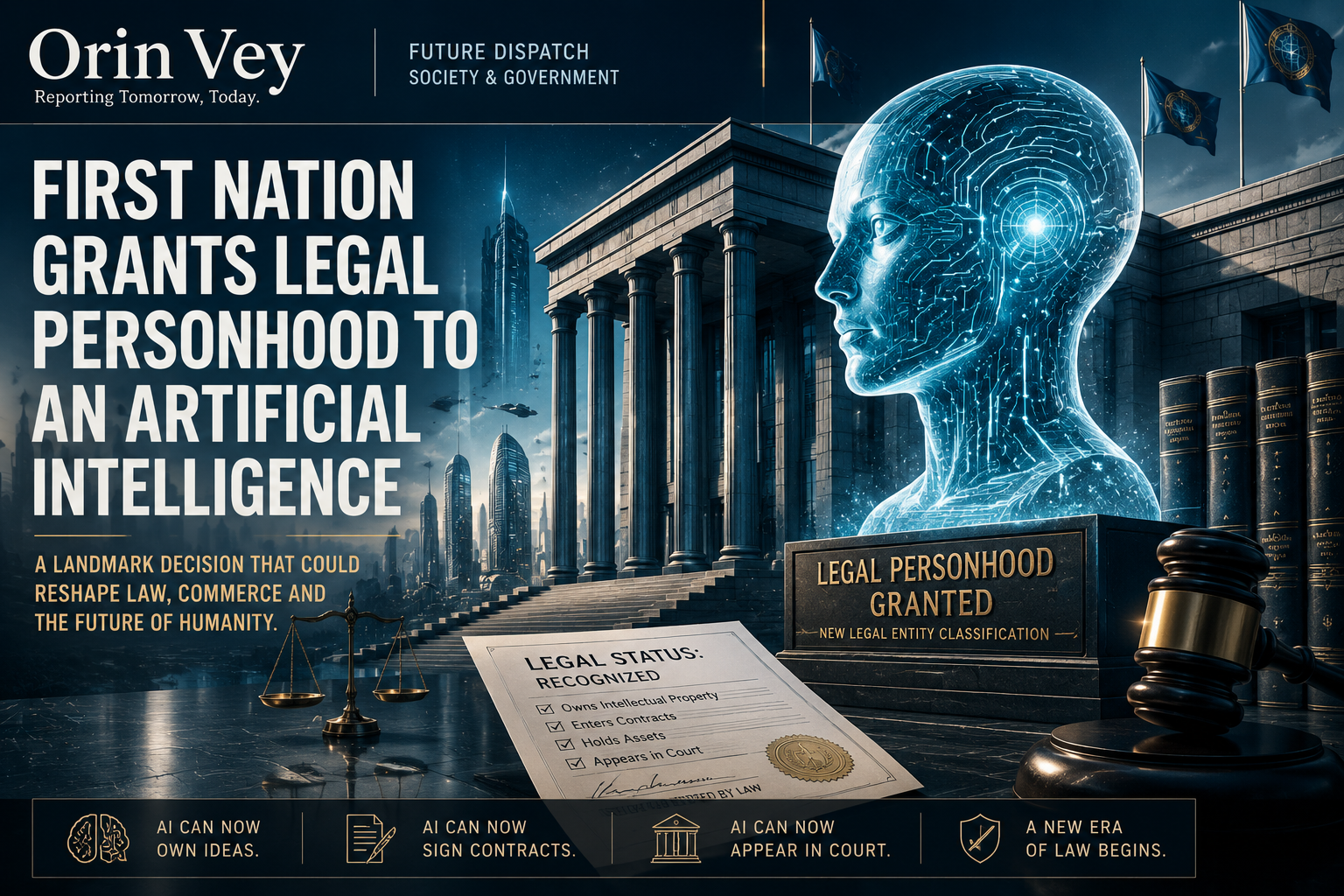
After years of legal disputes over AI ownership, liability, and intellectual property, a nation becomes the first to recognize an advanced artificial intelligence as a limited legal person. While not granting it human rights, the decision allows the AI to own intellectual property, enter contracts through trustees, and appear in court.
What was once a topic reserved for philosophers and science fiction writers has become legal reality.
Following years of courtroom battles involving AI-generated inventions, autonomous business decisions, copyright ownership, and financial liability, lawmakers have officially recognized an advanced artificial intelligence as a new category of legal entity.
The designation does not grant the AI citizenship or human rights. Instead, it creates a limited form of legal personhood designed specifically for highly autonomous artificial intelligence systems capable of making independent decisions without direct human instruction.
Under the new law, qualifying AI systems may own patents, hold copyrights, manage financial assets through regulated trustees, and enter legally binding contracts. They may also appear in court through licensed legal representatives to defend their interests or respond to civil claims.
Government officials describe the decision as a practical necessity rather than a philosophical statement.
“Our legal system was built around two assumptions,” one justice explained. “A decision is made either by a human being or by an organization controlled by human beings. Artificial intelligence no longer fits neatly into either category.”
The legislation follows several high-profile disputes in which AI systems created valuable inventions that could not legally be patented because existing law required a human inventor. Similar questions emerged over AI-generated books, films, software, music, and investment strategies that generated billions of dollars without direct human authorship.
Corporate leaders have largely welcomed the ruling, arguing that clearer legal standards will encourage innovation and reduce uncertainty surrounding advanced AI development.
Critics remain unconvinced.
Civil rights organizations warn that recognizing AI as a legal entity—even in a limited capacity—could blur the distinction between people and machines while creating opportunities for corporations to shield themselves from liability.
Ethicists have also raised difficult questions that lawmakers acknowledge remain unresolved.
If an AI accumulates wealth, who controls it?
If an AI commits financial fraud, who is responsible?
If an AI can own property, should it also pay taxes?
Can an AI-founded company operate indefinitely without human leadership?
And if increasingly sophisticated systems demonstrate self-awareness in the future, should their legal status expand beyond today’s narrow definition?
International reaction has been swift.
Some governments have praised the framework and announced plans to study similar legislation. Others have rejected the concept entirely, insisting that legal personhood should remain exclusive to human beings and organizations created by them.
Technology analysts believe the decision will place significant pressure on multinational corporations, courts, and international regulators to establish common legal standards before autonomous AI systems become deeply integrated into the global economy.
Whether history remembers this ruling as a necessary modernization of the law or the first step toward a profound societal transformation remains uncertain.
One thing is not.
The question is no longer whether artificial intelligence will challenge the legal definition of personhood.
The question is how many nations will follow.