Future Dispatch
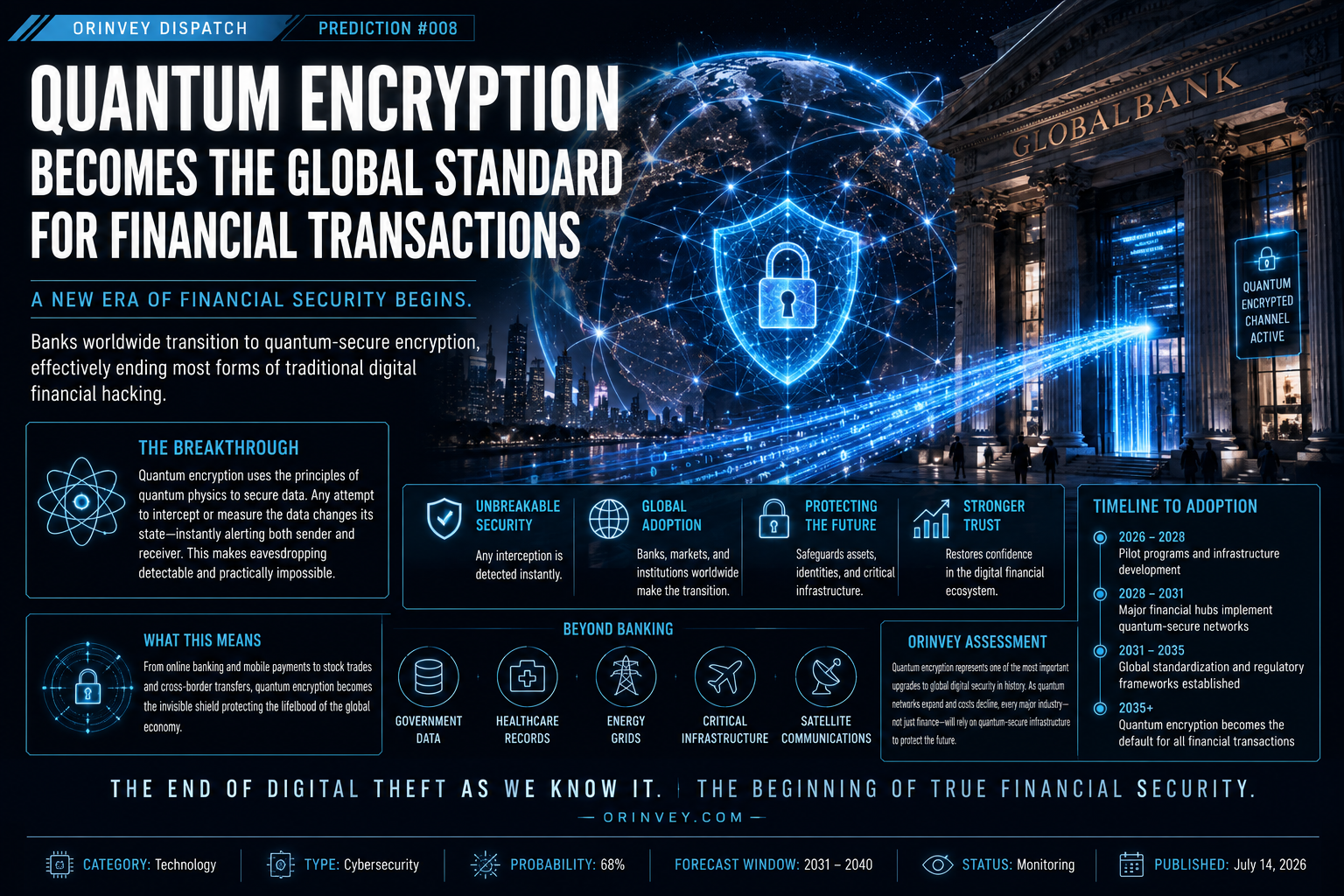
Banks, payment networks, stock exchanges, and financial institutions worldwide adopt quantum-secure encryption as the default standard for digital transactions, sharply reducing conventional cyberattacks and protecting the global financial system against future quantum-computing threats.
In what financial regulators are calling the most important security transition since the creation of modern online banking, quantum-secure encryption has officially become the global standard for financial transactions.
The change follows years of coordinated upgrades across banks, credit-card networks, stock exchanges, payment processors, central banks, and international settlement systems. From routine purchases and mobile banking to billion-dollar institutional transfers, financial data is now protected by encryption designed to resist both conventional cyberattacks and the advanced capabilities of quantum computers.
The transition was driven by growing concern that sufficiently powerful quantum computers could eventually break many of the cryptographic systems that had protected digital commerce for decades. Although those systems remained secure against traditional machines, their long-term vulnerability created a serious threat to financial records, private communications, stored credentials, and encrypted data collected for future decryption.
Rather than waiting for a major breach, governments and financial institutions began replacing vulnerable systems with post-quantum cryptography and quantum-secure communications.
The new global standard combines several technologies. Post-quantum algorithms protect most everyday transactions using mathematics designed to withstand quantum attacks, while quantum key distribution is deployed across the most sensitive financial networks. These systems allow institutions to detect interception attempts and securely exchange encryption keys over dedicated fiber, satellite, and metropolitan communication networks.
The result is one of the largest coordinated cybersecurity upgrades in history.
Banks begin issuing quantum-secure digital identities to customers, replacing many passwords and reusable credentials with cryptographic authentication tied to trusted devices and biometric verification. Stolen login information becomes far less useful because authorization codes are temporary, transaction-specific, and nearly impossible to reproduce.
International transfers also become faster and more secure. Financial institutions exchange verified payment instructions through encrypted networks capable of confirming the identity of both parties before funds move. Fraud-detection systems powered by artificial intelligence monitor transactions simultaneously, identifying suspicious behavior without exposing the underlying financial data.
Stock exchanges and major investment firms adopt quantum-resistant systems to protect trading platforms from manipulation, data interception, and attacks designed to disrupt markets. Central banks require institutions operating within their jurisdictions to meet common encryption standards, while international regulators create certification programs verifying that financial infrastructure is prepared for the quantum era.
The transition does not eliminate financial crime entirely. Social engineering, insider threats, identity fraud, and compromised personal devices remain serious risks. However, traditional attacks based on stealing encrypted information, intercepting transactions, or breaking outdated security protocols decline sharply.
The benefits quickly spread beyond banking.
Governments apply similar protections to tax records, national identification systems, and classified communications. Hospitals secure medical files, utilities protect energy grids, and telecommunications companies upgrade the networks carrying sensitive public and commercial data. Satellite operators deploy quantum-secure links to protect communications between continents and remote regions.
The cost of the transition is substantial. Financial institutions spend hundreds of billions of dollars replacing aging infrastructure, retraining security teams, updating software, and testing compatibility between national systems. Smaller banks and developing nations initially struggle with the expense, prompting international funding programs and shared security platforms.
Despite those challenges, public confidence in digital finance rises as large-scale breaches become less common and stolen financial data becomes increasingly difficult to exploit.
Historians later identify the transition as the moment cybersecurity shifted from reacting to attacks toward designing systems that made entire categories of attack obsolete. Quantum encryption did not create a world without financial crime, but it established a stronger foundation for the increasingly digital global economy.
⸻
OrinVey Assessment
The adoption of quantum-secure encryption across the financial sector is highly plausible because institutions must begin preparing before large-scale quantum computers become capable of threatening existing cryptographic systems. The transition will likely rely more heavily on post-quantum cryptography than on pure quantum communication, especially for consumer transactions and ordinary banking infrastructure. Quantum key distribution will probably remain concentrated in central banks, settlement networks, major exchanges, and other high-security environments.
If global adoption occurs, the milestone would represent one of the most important cybersecurity upgrades in modern history. It would protect financial systems against future quantum threats, strengthen digital identity, reduce certain forms of fraud, and establish security standards later adopted across government, healthcare, energy, and communications.