Future Dispatch
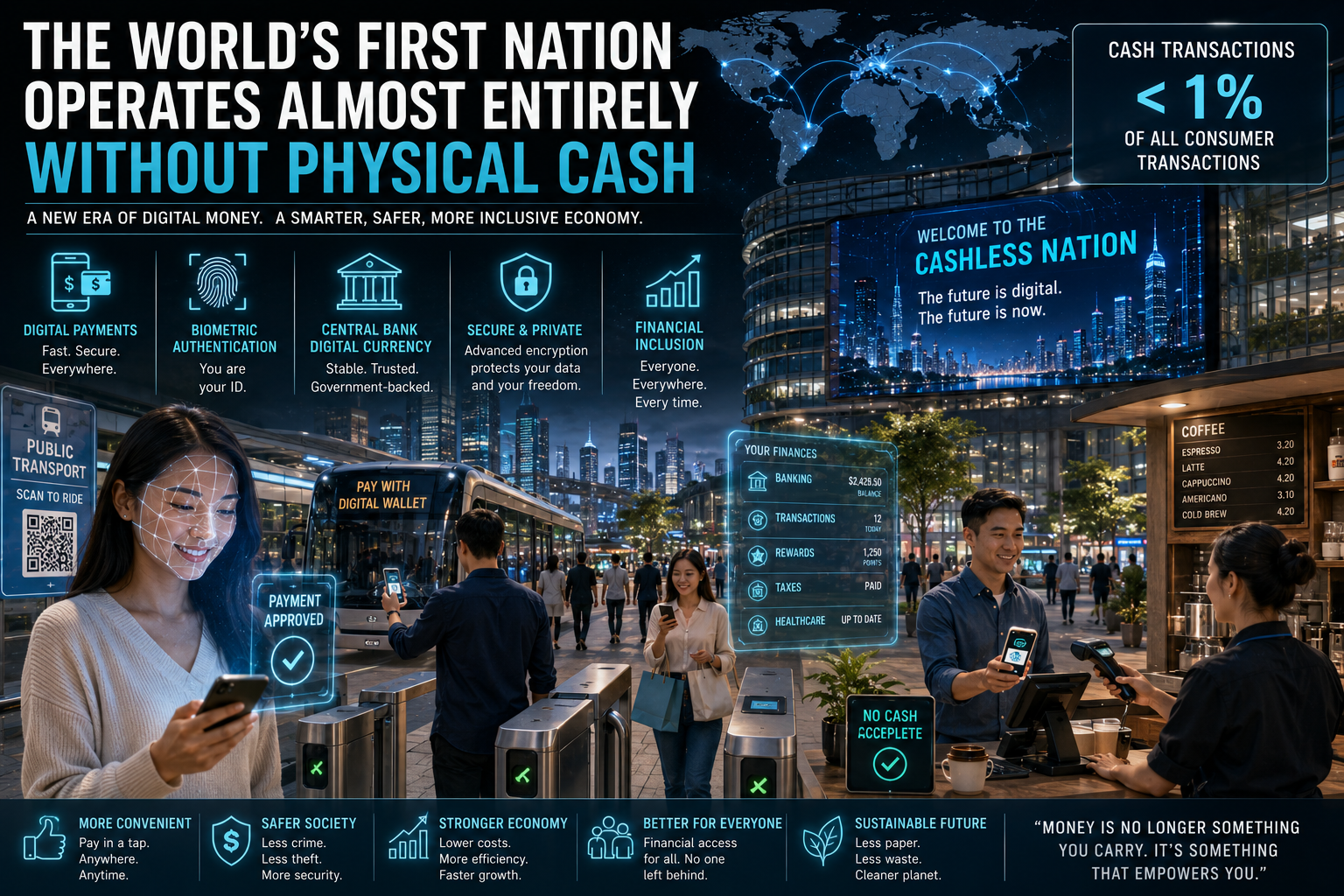
The first country becomes effectively cashless as more than 99% of consumer transactions are completed digitally through secure payment platforms, biometric authentication, and central bank-backed digital currency, fundamentally changing how people spend, save, and conduct business.
Future Dispatch
In what economists are calling one of the most significant financial transformations since the invention of modern banking, the world’s first nearly cashless nation has officially reduced physical currency to less than one percent of all consumer transactions.
Government officials confirmed today that paper money and coins remain legal tender, but their everyday use has become exceptionally rare. Nearly every purchase—from groceries and public transportation to home sales and tax payments—is completed instantly through secure digital payment networks.
The transition did not occur overnight.
For more than a decade, financial institutions invested heavily in digital payment infrastructure, biometric authentication, and fraud prevention technologies. Mobile banking applications evolved into comprehensive financial platforms capable of managing identification, tax records, insurance, healthcare payments, and personal finances through a single secure digital identity.
Small businesses, once hesitant to abandon cash, gradually adopted low-cost digital payment systems that settled transactions almost instantly while reducing theft, accounting errors, and cash-handling expenses.
The nation’s central bank also introduced a government-backed digital currency that operates alongside commercial banking systems. Unlike cryptocurrencies, the digital currency maintains a stable value, functions as legal tender, and integrates directly into existing financial institutions while providing faster settlement and lower transaction costs.
Consumers now authorize purchases through facial recognition, fingerprint authentication, wearable devices, or secure digital wallets rather than cash or traditional payment cards.
The shift dramatically reduces several forms of financial crime. Counterfeit currency virtually disappears, armed robberies targeting cash businesses decline, and tax collection becomes more efficient due to improved transaction transparency.
Financial inclusion also expands.
Citizens in remote communities gain immediate access to banking services through smartphones and satellite internet connections, eliminating the need to travel long distances to physical bank branches. Government benefits, disaster relief payments, and emergency assistance are distributed within minutes instead of days.
Despite the benefits, civil liberties organizations continue raising concerns about privacy, surveillance, and resilience. Critics argue that governments and financial institutions must ensure citizens retain reasonable financial privacy while protecting the system from cyberattacks, infrastructure failures, and abuse of centralized authority.
To address those concerns, lawmakers establish strict legal safeguards governing transaction data, anonymous low-value purchases, independent oversight, and emergency offline payment capabilities during natural disasters or major network outages.
Following the nation’s success, several neighboring countries announce similar roadmaps toward reducing dependence on physical currency. International payment networks begin developing common standards to allow seamless cross-border digital transactions, accelerating the globalization of digital finance.
Historians later identify the transition as the moment physical cash shifted from being a daily necessity to a specialized backup payment method, much like handwritten letters in the age of email.
⸻
OrinVey Assessment
The movement toward a cash-light society is already underway in many parts of the world, driven by mobile payments, contactless transactions, digital banking, and government interest in central bank digital currencies. While the complete elimination of cash remains unlikely in the foreseeable future, a nation where physical currency accounts for less than one percent of transactions is a realistic possibility.
Such a milestone would reshape commerce, taxation, banking, cybersecurity, and financial regulation while raising important questions about privacy, digital access, and individual financial freedom. If realized, it would mark one of the most significant economic transitions of the twenty-first century.