Future Dispatch
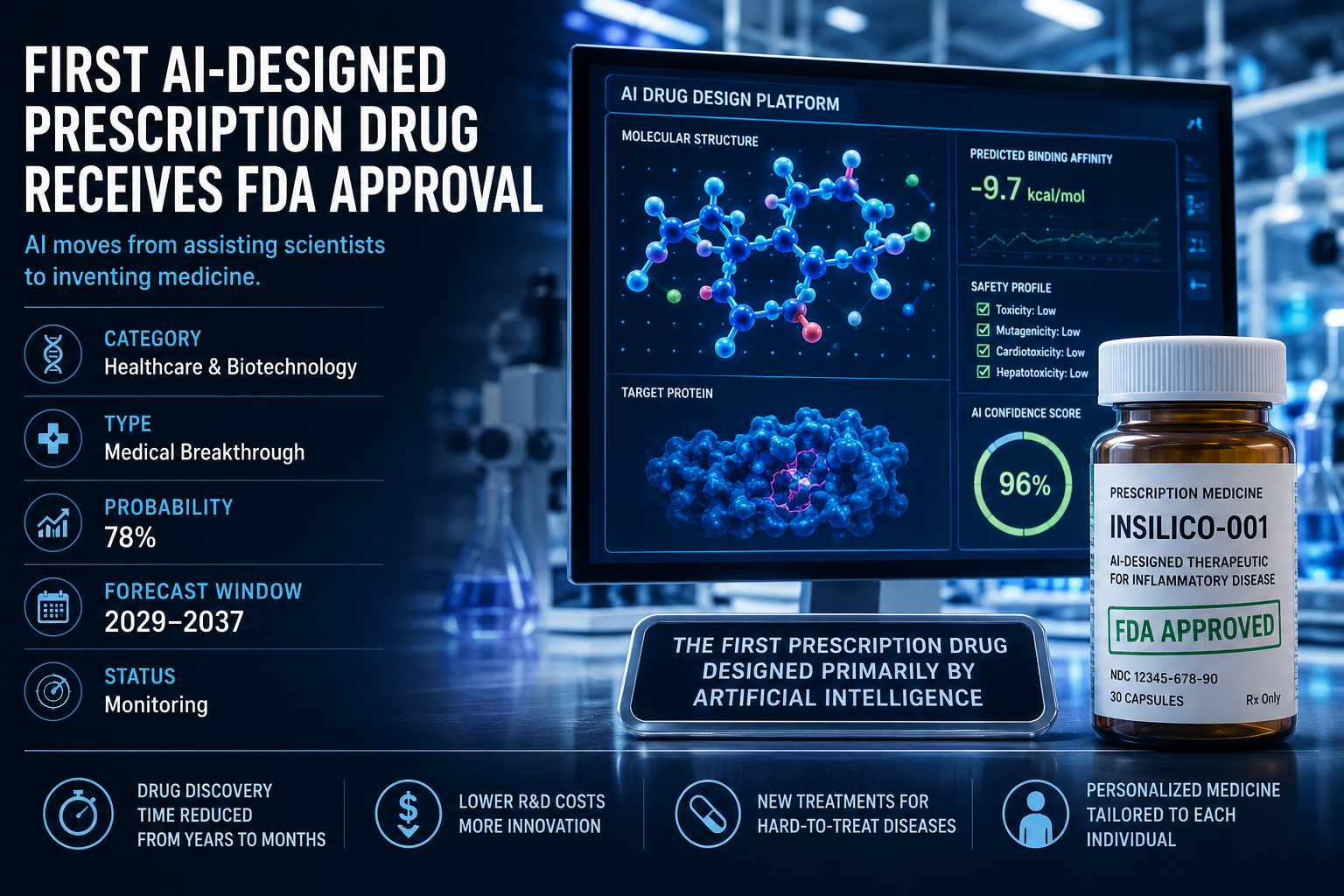
A prescription medication designed almost entirely by artificial intelligence receives full regulatory approval, demonstrating that AI has become one of the primary engines of pharmaceutical research and dramatically reducing the time and cost required to develop new medicines.
Future Dispatch
For more than a century, developing a new prescription drug has been one of the most expensive, time-consuming, and uncertain processes in science. On average, bringing a single medication from discovery to pharmacy shelves has required more than a decade of research, billions of dollars in investment, and the failure of thousands of potential compounds along the way.
That process is beginning to change.
Artificial intelligence has rapidly evolved from a research assistant into a scientific collaborator capable of analyzing biological systems on a scale no human team could match. Modern AI platforms now evaluate billions of molecular combinations, predict protein structures, simulate chemical interactions, estimate side effects, and identify promising drug candidates in a matter of days rather than years.
In what many experts consider the beginning of a new era in medicine, regulators approve the first prescription drug whose molecular structure was designed primarily through artificial intelligence.
Human scientists remain responsible for laboratory validation, clinical trials, manufacturing, and regulatory oversight. However, the creative process of identifying and engineering the compound itself belongs largely to AI.
The approval represents far more than a technological milestone.
Pharmaceutical companies immediately expand investments into AI-driven research platforms, shifting billions of dollars away from traditional discovery methods. Universities redesign medical and pharmaceutical curricula to include AI-assisted molecular engineering, while governments begin funding national AI drug discovery initiatives to improve public health preparedness.
The economic effects are equally significant.
Drug discovery costs begin falling as AI dramatically reduces the number of failed candidates entering expensive clinical trials. Smaller biotechnology firms gain the ability to compete with industry giants by using powerful AI systems instead of maintaining massive research departments.
Patients benefit from shorter development timelines for treatments targeting cancer, Alzheimer’s disease, rare genetic disorders, antibiotic-resistant infections, autoimmune diseases, and numerous other conditions that previously required decades of research.
Perhaps the greatest transformation comes through personalized medicine.
Instead of producing one medication for millions of patients, physicians increasingly prescribe treatments designed around an individual’s unique genetic profile, medical history, and predicted biological response. AI systems continuously refine molecular structures to maximize effectiveness while minimizing adverse reactions, ushering in an era where medicine becomes increasingly individualized rather than standardized.
Healthcare systems also become more resilient during global health emergencies.
When new viruses or antibiotic-resistant bacteria emerge, AI platforms can rapidly analyze their biological characteristics and generate thousands of potential therapeutic compounds within hours. What once required years of laboratory work can now begin almost immediately, allowing researchers to move promising candidates into testing far faster than ever before.
Ethical and regulatory challenges remain.
Medical professionals debate how much autonomy AI should have in designing life-saving therapies. Regulators establish new approval standards to verify that AI-generated compounds are transparent, explainable, reproducible, and safe. Questions surrounding intellectual property also emerge as courts determine whether discoveries made primarily by artificial intelligence can be patented in the same manner as traditionally developed medicines.
Despite those debates, the broader trend becomes unmistakable.
Historians eventually describe the approval of the first AI-designed prescription drug as the moment pharmaceutical research entered the AI era. Just as computers transformed genetic sequencing and medical imaging decades earlier, artificial intelligence fundamentally reshapes how humanity discovers, develops, and delivers new medicines.
For patients awaiting treatments that have remained out of reach for generations, the breakthrough represents more than technological progress—it offers the possibility that some of medicine’s most difficult challenges may finally become solvable.